Screen-free gifts for ages 0 to 5, by age
By Adam Linmore · November 15, 2026
Every December the same question comes from grandparents, aunts and friends: what does she want? For a child under five the honest answer is often "you, on the floor, for twenty minutes." A good toy makes that easier. It gives the two of you something to pass back and forth, build and knock down, or talk about. This page sorts gift ideas by age and ends with a few for the grown-ups on your list. For our earlier list of gift ideas, see Screen-free gifts for toddlers and preschoolers.
What makes a toy last past January
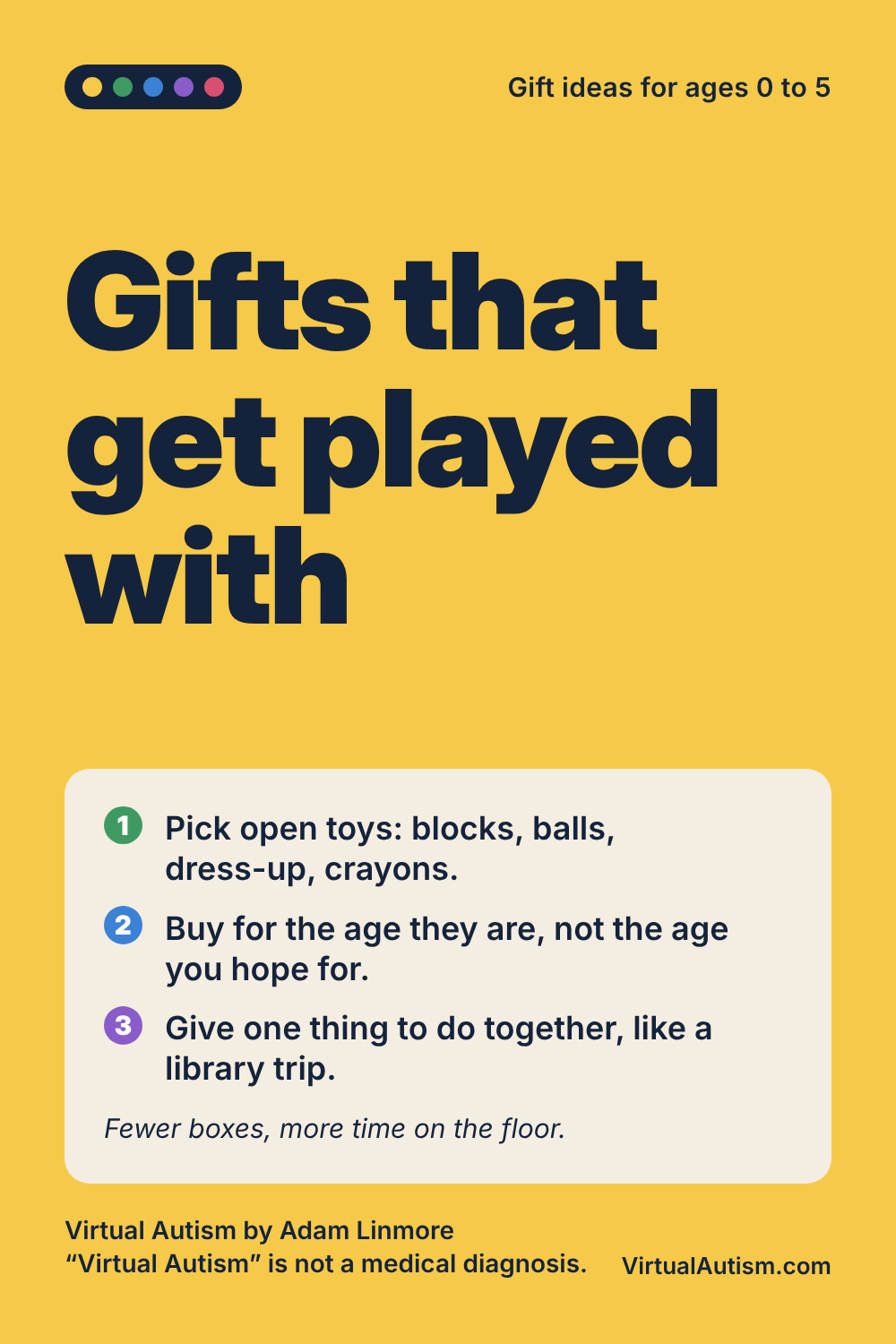
The toys that stay out of the closet tend to share a few traits. They can be used more than one way, so a set of blocks is a tower on Monday and a fence for the farm animals on Friday. They do the least, so the child does the most: a plain wooden car rolls only as far as she pushes it. And they invite a second person in. A ball needs someone to roll it back.
Toys with a screen, a speaker that talks on its own or a button that does the whole job tend to be played with once and then watched. That is not a reason to feel bad about one already in the house. It is a reason to put the next gift dollar somewhere else.
A safety note before the list. For a child under three, or any child who still puts things in her mouth, skip anything small enough to fit through a toilet-paper tube, button batteries, small magnets and long cords. Check the age label on the box, and buy for the age the child is, not the age you hope she will reach by spring.
Birth to 12 months
Soft cloth books with one picture to a page and high contrast. She will chew them, and that is fine.
A small unbreakable mirror for tummy time, propped where she can see herself.
Stacking cups. Babies knock them over long before they stack them, and knocking over is the fun part.
A basket of safe household things: a wooden spoon, a clean whisk, a silicone lid. Babies love real objects.
Ages 1 to 2
Chunky wooden blocks or soft foam blocks.
A push toy for a child who is pulling up or just walking, such as a sturdy walker wagon that holds blocks.
Simple shape sorters and peg puzzles with three to five pieces and big knobs.
A light ball she can carry and throw indoors.
Pretend kitchen basics: a pot, a spoon and a few pieces of play food. Toddlers copy what you do, and stirring is a big job.
Ages 2 to 3
Crayons and big paper. A roll of plain paper taped to the floor is a gift that lasts weeks.
Toy animals and a few vehicles, the kind she can line up, sort and drive into a block garage.
Play dough with a rolling pin and a few cutters. Sit down and make a snake together.
A doll or soft animal with a blanket, for feeding, rocking and putting to bed.
Picture books with a repeating line she can say with you before she can read.
Ages 3 to 5
Dress-up clothes: a hat, a cape, a vest, a bag. A box of old scarves counts.
Bigger building sets, magnetic tiles or wooden train track, which grow with her for years.
First board games that use turns, colors and counting, short enough to finish before anyone gets restless.
A child-sized tool: a small broom, a watering can, safety scissors with a stack of old magazines.
Card games for talking and taking turns. Our 52 Play and Talk Cards are a printable deck of plays for a grown-up and a young child ($7.00), and the 150 "I'm Bored" Play Cards give her something to pick from when the afternoon is long ($6.50).
Give fewer things, and give one thing to do
A child who opens fifteen boxes in a morning often plays with the paper. Some families use a small rule for holidays and birthdays, such as one thing to play with, one book and one thing to wear. Others put half the toys away after the holiday and swap them out each month, so the old ones feel new again.
An outing can be the best gift of all. A trip to the library, a ticket to a children's museum, or a promise of "Saturday pancakes with Grandpa" written on a card gives the child time with someone who loves her, which is the part she will remember.
If a relative asks what to buy, it is fine to say so plainly. "She is really into animals right now, and we are trying to keep screens for later" is clear and kind.
For the grown-ups on your list
Our gift page is sorted by person, with holiday ordering dates for each item. A few that fit a family trying for more play and fewer screens:
For a grandparent who reads aloud: the Grandma Reads Sweatshirt or the Grandpa Reads Sweatshirt, or the Story Time Is My Screen Time Tote Bag for the weekly library trip.
For the playroom door: the Screen-Free Room Sign.
For a parent of a toddler: the book Virtual Autism, which explains how young children learn to talk through turns with a person, and what to do instead of a screen.
When to talk to your child's doctor
A gift list is not a check on how a child is doing. If something about your child's talking, play or development worries you, ask your child's doctor; that conversation is always worth having.
For more ideas sorted by age, see Screen-free activities by age.
Sources: World Health Organization 2019; American Academy of Pediatrics 2016. Full references are in Virtual Autism and on the Sources page.
Written with AI assistance and checked against the cited sources.
“Virtual Autism” is not a medical diagnosis.