A travel day with a toddler, without a tablet
By Adam Linmore · November 15, 2026
Holiday travel with a small child is a long day of waiting: in lines, at gates, in seats, in a relative's hallway at bedtime. A tablet looks like the easy answer, and on some trips a parent will reach for it, which is understandable. This page is for families who want to try the day with less of it. It covers what to pack, games for airports, planes and trains, and how to settle into a new place. For long drives, see What to do in the car without a tablet.
The day before: tell the story of the trip
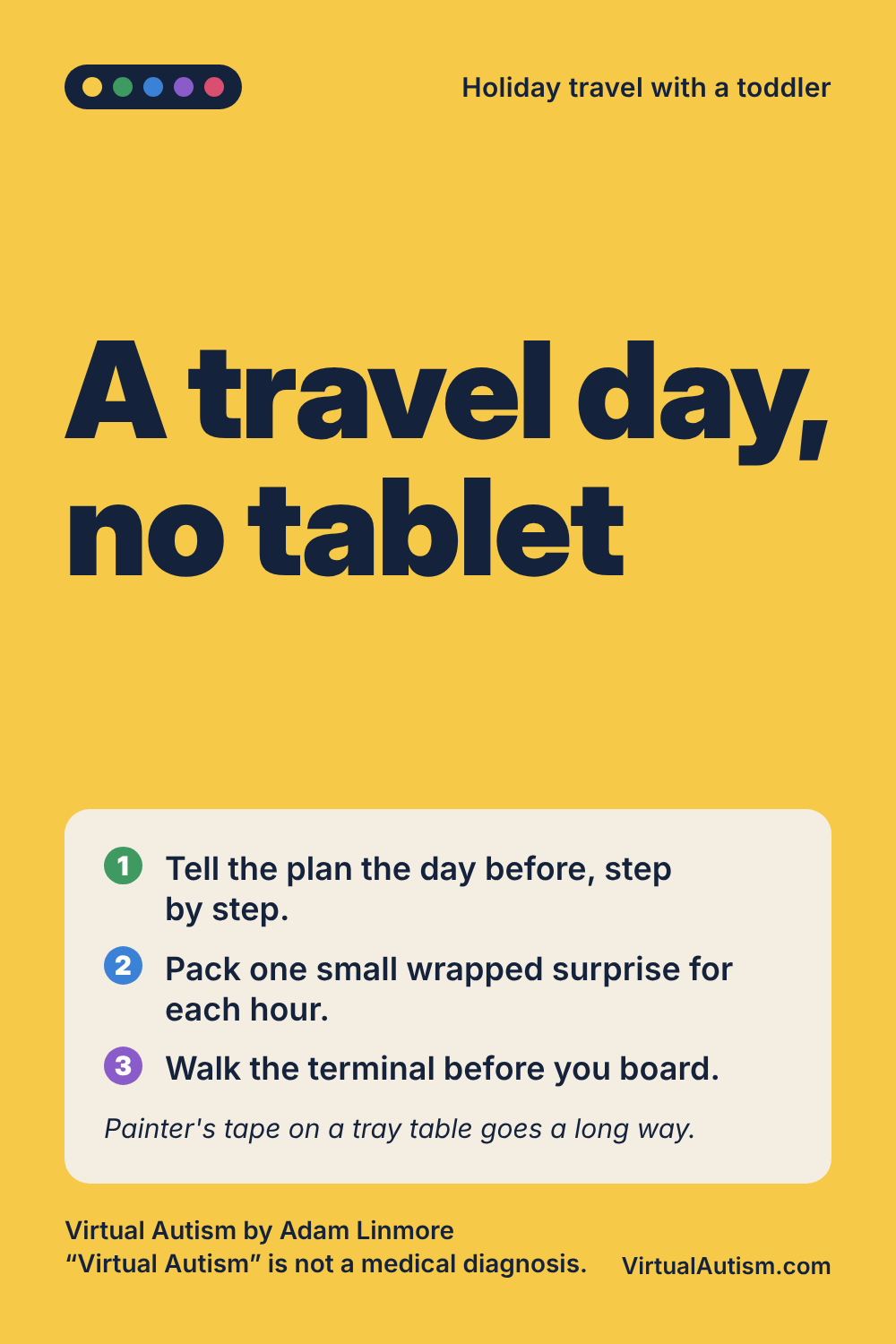
Young children cope much better when they know what is coming. The night before, tell your child the trip in order, in plain words: "First we take a taxi. Then we wait in a long line with our bags. Then we sit in the airplane, and it gets loud when it goes up. Then Grandma picks us up." Tell it again in the morning. A child of three or four can tell it back to you, and that is a game in itself.
Some families draw the day as a row of little pictures on one sheet of paper, one box for each step, and let the child cross off each box as it happens. Our 239 Visual Routine Cards and Charts include cards you can use the same way ($9.50).
What to pack
Pack for the hours, not the miles. A good rule is one small new thing for every hour of travel, wrapped in paper so the unwrapping is part of the fun. None of it needs to be expensive.
Wrapped surprises: a roll of painter's tape, a small notebook, a few stickers, a new board book, a toy animal she has not seen before.
A fat crayon or two and a pad of paper. Skip anything that rolls under seats.
Snacks in small containers, opened one at a time. Opening a box is an activity.
One comfort object from home: the blanket, the soft animal, the pillowcase that smells like her bed.
A change of clothes for her and a spare shirt for you.
Keep everything for the child in one bag you can reach from your seat. For a child under three, or any child who still mouths things, check that nothing in it is small enough to choke on.
At the airport or the station
Lines are where the day can go wrong, so treat them as part of the trip, not a gap before it.
Walk first. Before you board, walk the terminal or the platform with her. Watch the planes or trains, find the bathroom, ride the moving walkway. A toddler who has moved is a toddler who can sit.
Give her a job. She can hold the boarding passes (copies, not the real ones), pull a small bag, or count the gates you pass.
Play "I hear with my little ear." Airports and stations are full of sounds: announcements, beeping carts, rolling bags.
Find colors. "Find something red" works in any line.
On the plane or the train
Takeoff and landing are often the hard part for small ears. A feed, a bottle, a drink through a straw or a snack to chew can help her swallow as the pressure changes. If you are worried about her ears, ask her doctor before the trip.
Once you are up, unwrap one surprise at a time, and only when the last one has run its course. A few more games for small spaces:
Painter's tape on the tray table. She pulls it off, sticks it on, makes a road for a small car. It peels off clean.
Sticker stories. Put three stickers on a page and tell a story about them together.
Peekaboo with the seat-back pocket for a baby or young toddler.
The window. Name what you see: clouds, fields, a river, the tiny cars far below.
A walk down the aisle, when the seatbelt sign is off, to say hello to the flight attendant.
Expect some crying. Most people on a plane have been a small child or have raised one. Do what you can, and let the rest go.
When you get there
A new place at bedtime is hard for a lot of toddlers. Bring the parts of bedtime that travel: the same pajamas, the same two books, the same song. Do them in the same order you do at home, even if the room is strange. If she wakes in the night, a quiet "We are at Grandma's house, and I am right here" goes a long way.
Relatives often have a television on all day. It is fine to ask, kindly, for it to be off during meals or while the children are playing. Most grandparents would rather play anyway, and a box of old pots, a stack of books or a walk outside gives them a way in.
When it does not go to plan
Some travel days end with a tablet out for the last hour, and that is a day, not a failure. Tomorrow you can go back to the games. What a toddler remembers is the window, the snacks and the person sitting next to her.
Our Car Ride and Waiting Pack is a printable set of cards for travel and waiting ($5.99).
When to talk to your child's doctor
These ideas are for fun, not a check on how a child is doing. If something about your child's talking, play or development worries you, ask your child's doctor; that conversation is always worth having.
Sources: World Health Organization 2019; American Academy of Pediatrics 2016. Full references are in Virtual Autism and on the Sources page.
Written with AI assistance and checked against the cited sources.
“Virtual Autism” is not a medical diagnosis.