Winter break at home without screens: a simple plan
By Adam Linmore · November 15, 2026
Winter break can feel long when you have small children at home. The routine of daycare or preschool stops, relatives come and go, the weather keeps everyone in, and a screen fills the gaps. This page is not a list of activities. For that, see Indoor activities for toddlers on cold days and Screen-free activities by age. It is a plan for the shape of the two weeks, so the days hold together with less screen time and less effort from you.
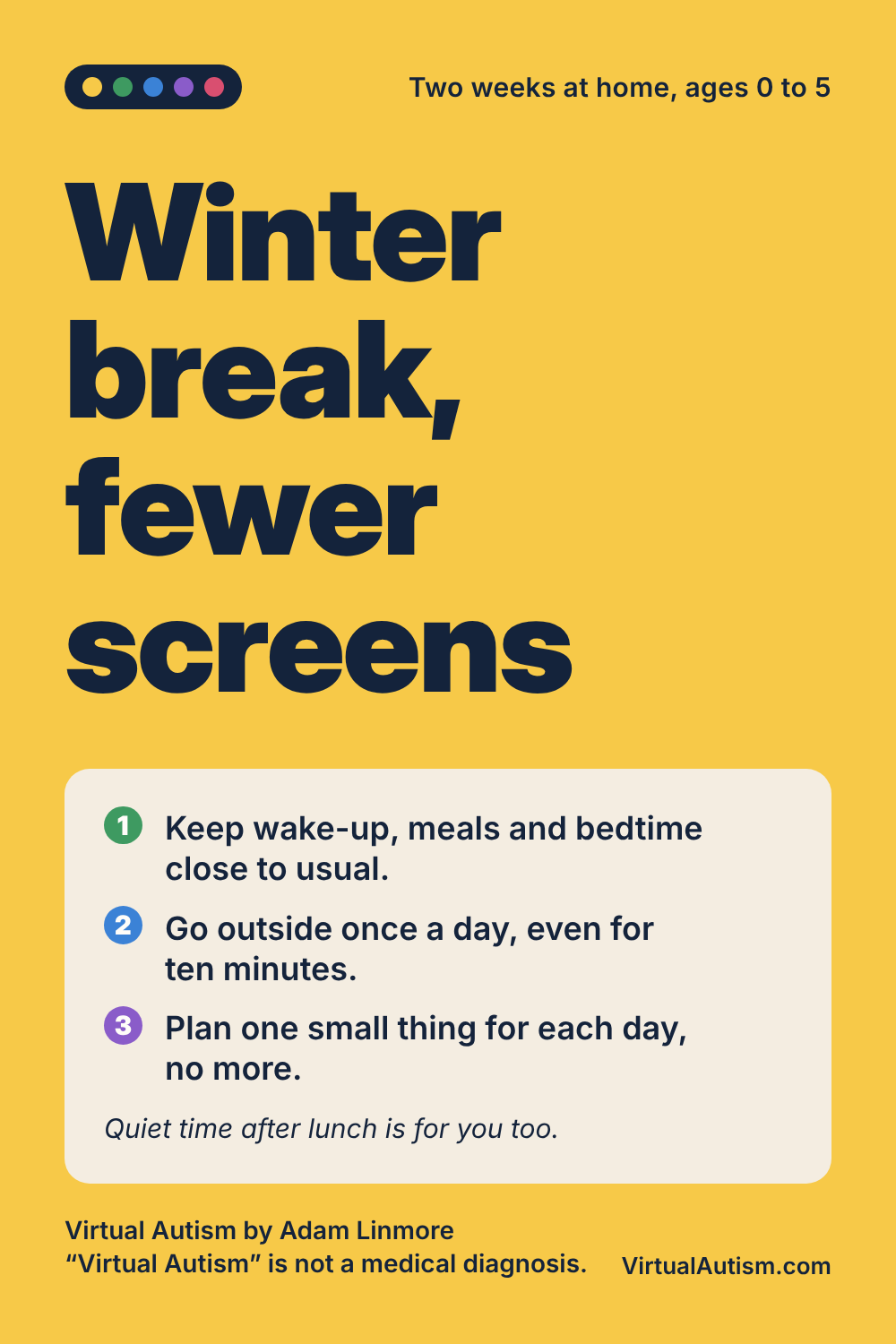
Keep the bones of the day
Children under five do better when the day has a shape they can predict. On a break, the shape tends to go first: late nights, late breakfasts, lunch at odd hours. You do not need a strict schedule, but keeping a few fixed points makes everything else easier.
Pick the parts of the school-day routine you want to keep. For most families that is wake-up time within an hour of the usual, meals at roughly the usual times, a nap or quiet rest after lunch, and the same bedtime steps every night. Everything between those points can change from day to day.
A simple rhythm that works for a lot of families:
Morning: breakfast, dressed, and out of the house or moving by mid-morning.
Late morning: the day's one planned thing.
After lunch: nap or quiet time, with books, puzzles or play on her own.
Late afternoon: a free hour, often the hardest part of the day, with one game ready.
Evening: dinner, bath and bed, the same as always.
One planned thing a day
A whole day of plans is tiring for everyone. One planned thing is enough. Write a short list at the start of the break, one idea for each day, and put it on the fridge. A three-year-old can help choose the order.
Ideas for the list:
A trip to the library to pick out holiday books.
Baking something simple, with her stirring and pouring.
A walk to look for a certain thing: a red door, a dog, a snowman.
Making paper snowflakes and taping them to the windows.
A visit to a friend's house, or a friend to yours.
Building a fort out of couch cushions and sheets, with lunch eaten inside it.
Setting up a pretend shop with things from the pantry and a basket.
Writing and drawing thank-you cards for gifts.
If you want the list made for you, our printable 24 Days of Play gives one small play idea for each day of a winter countdown ($6.50).
Outside, once a day
Even on a cold day, ten or twenty minutes outside resets a toddler. Dress her warmly, go out after breakfast, and let her stomp in puddles or snow, collect sticks or look for birds. A child who has been outside in the morning is usually calmer in the afternoon. On days with real ice or storms, a walk around the inside of a building, such as a library or a mall, counts too.
Rest, for her and for you
A break is not only for the children. Plan quiet time after lunch every day, even for a child who no longer naps. Put out a basket of books, a puzzle or crayons, set a timer, and let her play near you while you sit down. Start with ten minutes and build toward thirty.
You will not play all day, and you should not try. Children learn a great deal from playing on their own nearby while a grown-up cooks, folds laundry or reads. Talk to her while you work. Ask what she is building. Answer her questions. That back-and-forth is what matters.
Screens with a plan, if they come out
Many families still use some screen time over the break, especially on travel days or when a parent is sick. If you do, decide ahead of time when and how long, rather than in the moment, and watch with her when you can. The American Academy of Pediatrics suggests no more than one hour a day of quality programming for children two to five, with a grown-up watching too. A clear plan also makes the "time to turn it off" moment easier, because it was agreed before it started.
The week after
When school or daycare starts again, the first few days can be rocky. Start the usual bedtime two or three nights before the break ends, and talk about who she will see when she goes back. Tell the story of the first morning, the way you would before a trip.
When to talk to your child's doctor
These ideas are for play, not a check on how a child is doing. If something about your child's talking, play or development worries you, ask your child's doctor; that conversation is always worth having.
Sources: World Health Organization 2019; American Academy of Pediatrics 2016. Full references are in Virtual Autism and on the Sources page.
Written with AI assistance and checked against the cited sources.
“Virtual Autism” is not a medical diagnosis.