Do screens affect a toddler’s attention?
By Adam Linmore · November 15, 2026
Start with what the research does not say. It does not say that a tablet gives a child attention-deficit hyperactivity disorder, and it does not say that a toddler who has watched a lot of television is damaged. The claim that television makes children unable to pay attention is older than the tablet, and careful people have argued about it for twenty years. The argument is worth following, because it shows how a true finding can grow bigger than it is and then shrink smaller than it should be. What is left when the argument is done is small, useful and nobody’s fault.
The study that made the headlines
In 2004 a group in Seattle used a large American survey to ask whether television in the first years predicted attention problems later. It did. Each hour a day of television at ages one and three went with about a 10 percent higher chance of attention problems at age seven, as reported by parents. The study made headlines around the world, and it is still the one quoted when someone says that screens cause attention-deficit hyperactivity disorder.
It does not say that. The attention problems were a parent’s rating, not a diagnosis, and the children’s viewing was reported from memory. When other researchers reanalyzed the same data, they found that any association appeared only at very high levels of viewing, and that it disappeared when two more of the family’s circumstances were taken into account. A separate study drew on a different national sample, about 5,000 American kindergartners, children of five or six in their first year of school, and found no meaningful relationship at all. The same Seattle group then looked at what the children were watching, and found that violent and purely entertainment programs before age three went with later attention problems and educational ones did not.
The fairest reading
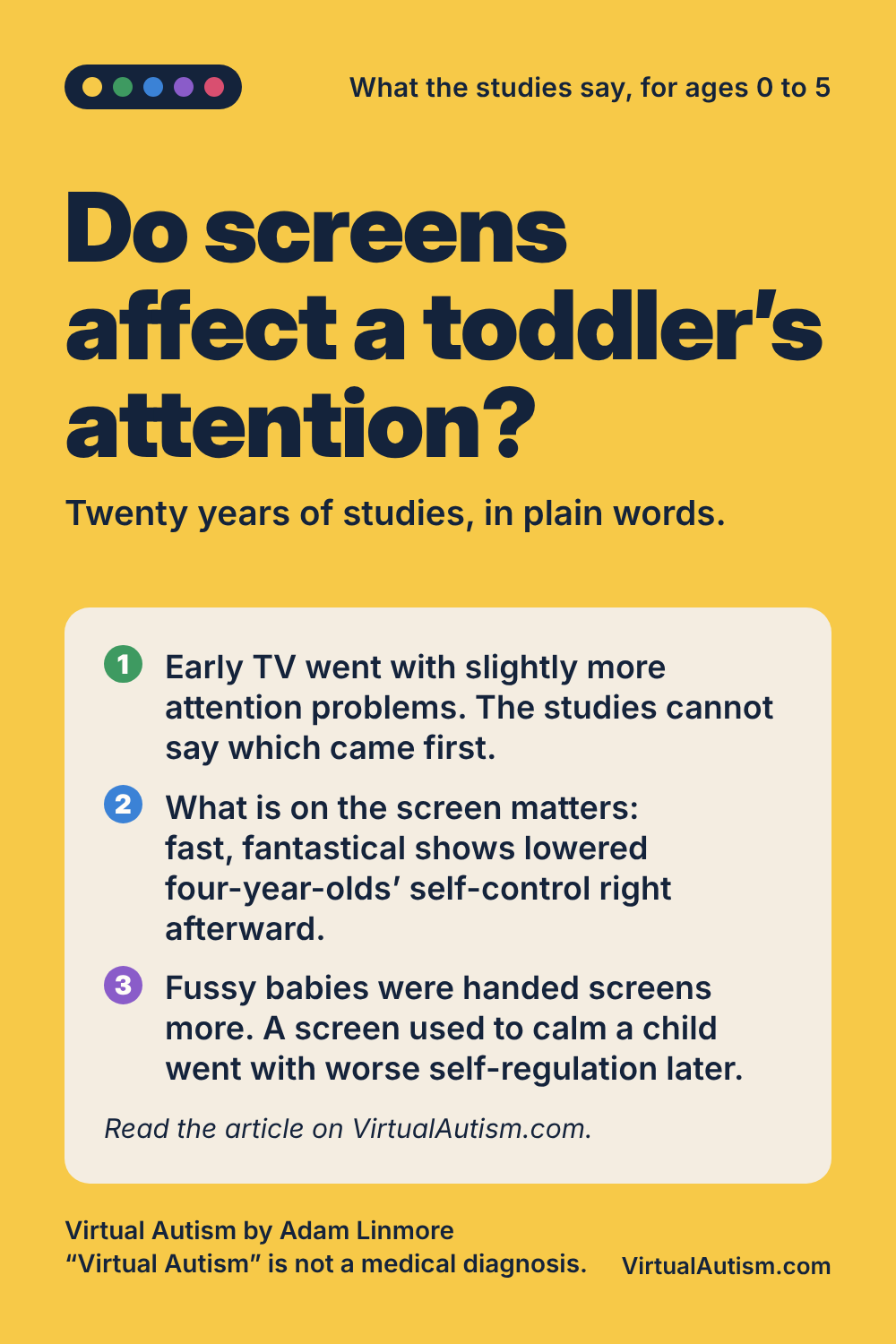
The fairest reading comes from a meta-analysis that pooled 45 studies of children’s media use and attention-deficit behaviors. It found a small positive association: more media went with slightly more attention problems. The association held across ages and types of media, and the studies could not show which came first.
Small is not nothing in a population, and small is also not the sentence the headlines wrote. Newer studies that follow the same children over years have found the same shape, with stronger associations at the top of the range. In a Canadian study that followed children from birth, five-year-olds with more than two hours a day of screens, compared with those under half an hour, had about five times the odds of behavior problems serious enough to concern a clinician, inattention among them. They also had more than seven times the odds of meeting criteria for attention-deficit hyperactivity disorder on a parent checklist. A checklist is still a checklist, and the children at the top of the range were a minority of the sample.
Two findings about how it might work are more useful to a parent than the argument about size.
What is on the screen matters
The first is about content. In one experiment, four-year-olds who watched nine minutes of a fast-paced cartoon did worse immediately afterward on tests of self-control than children who had drawn with crayons. Later experiments from the same laboratory pulled apart the speed of the cuts and the content, and found that the content was what mattered: shows full of impossible, fantastical events lowered four-year-olds’ self-control afterward whether they were fast or slow.
The effects were measured only right after viewing, and nobody knows what nine minutes a day for three years adds up to. The finding is still a reason to prefer programs about ordinary events, at an ordinary pace, if there are to be programs at all.
The loop that starts with a fussy baby
The second finding is about direction, and it may be the most reassuring thing in this field for a tired parent. Among more than 7,000 American infants, the ones whose parents described them at nine months as hard to soothe and hard to settle were watching more television at two years than babies who were easier to soothe. Once other differences were accounted for, the gap was about nine minutes a day on average. Babies whose problems lasted to age two watched more still and were more likely to watch over two hours a day.
In this study the fussiness came first, and the extra television followed. Many families know the loop that starts there: a fussy baby, a tired parent, a screen that works, a baby who learns that the screen is how fussing ends.
The same researcher’s later work followed the loop forward. Among 422 American parents of three- to five-year-olds, those who often used a phone or tablet to calm an upset child had children who, six months later, were more emotionally reactive, with quicker swings of mood and more impulsive behavior. The association was clearest in boys and in children who were already intense by temperament. The device works in the moment, and the moment is the point. As the book puts it, a child who is calmed by a screen does not practice calming herself, and a parent who calms a child with a screen does not practice the other ways. Both lose a turn.
A child who is hard to settle is not a child the screen has broken. She is a child who arrived that way and was given the one thing that worked, and she can be given the other things now.
What to add this week
The practical rules that follow from all this are short.
Slow shows about ordinary things. Nothing with a fight in it, nothing full of impossible events. The experiments on content are a reason to prefer them, if there are to be programs at all.
No screen to quiet a crying child, however well it works. Using a device to calm a child is associated with worse self-regulation later. This is the hardest rule, and the one with the most behind it.
Something else for the hardest hour. The hour a tired parent most needs a child to be still is the hour the screen can seem like the only thing that works. Keep a few things ready for it: a basket of board books, a bowl of water and a cup at the sink, a drawer she is allowed to empty, a walk to the mailbox. What to do instead of screens has twenty-five more, sorted by the moments screens usually fill.
A plan for the moment the screen goes off. Switching off is hard for children, and a calm, repeated sequence helps. How to turn off screens with less protest gives ten steps.
Expect a loud week. Taking a screen away from a child who has used it to settle makes the hard hour worse at first. That is not a sign she needed the screen; it is a sign she had not yet learned the other way, and the loud week is where she learns it.
Movement every day. The World Health Organization asks for at least three hours of physical activity a day, spread across the day, from age one to four, and sets its screen limit in the same recommendation because the two compete for the same hours.
What this does not mean
It does not mean that a child who struggles to sit for a book, or who melts down when the tablet goes off, has an attention disorder, and it does not mean that screens gave her one. Attention-deficit hyperactivity disorder is a diagnosis a clinician makes, over time, with the family. The studies above measured parent ratings and checklists in large groups of children; they say something about populations and much less about any one child. A toddler’s attention is also short by design.
What the research supports is modest and doable: fewer fast, fantastical shows; no screen as the pacifier; a day with plenty of moving and plenty of turns with a person. Screen time by age puts the guidelines for each age in one place, and a family media plan is the easiest way to make the new habits stick.
If you are worried
If your child’s attention, play, talking or looking worries you, or she has lost a skill she had, talk with your child’s doctor now, and ask for a hearing test first. No parent is to blame for a child’s temperament or her development, and the loop between a fussy baby, a tired parent and a screen is nobody’s fault; it can be interrupted at any point. “Virtual Autism” is not a medical diagnosis; if that phrase brought you here, read what it means.
Sources: Christakis et al. 2004; Foster and Watkins 2010; Stevens and Mulsow 2006; Zimmerman and Christakis 2007; Nikkelen et al. 2014; Tamana et al. 2019; Lillard and Peterson 2011; Lillard et al. 2015; Radesky et al. 2014a; Radesky et al. 2023; World Health Organization 2019. Full references are in chapters 4 and 10 of Virtual Autism; the sources page lists the key studies behind this site.
Written with AI assistance and checked against the cited sources.