Screens at the grandparents’ house
By Adam Linmore · November 15, 2026
Holiday visits bring a familiar moment. A toddler arrives at her grandparents’ house, the television is on, and somebody has to decide whether to say anything. Nothing here says that grandparents are doing it wrong. Many grandparents raised children with a television in the house and feel those children turned out fine, and they may well be right. What the research does say is that a few things have changed since then, and that a grandparent has something a small child needs that no screen can give her.
What changed since your own children were small
None of these changes is a judgment on anyone. They are changes in the screens themselves, and in what researchers have learned.
The amount. The television of 1985 was usually in one room and showed children’s programs mostly at set hours. Today’s screens are in every room and every pocket, they never stop, and some programs are made specifically for babies. Large American surveys find children under two in front of screens for about an hour a day, and two- to four-year-olds for more than two hours. Those are averages, and many families are well above them.
The design. A program used to end, and a child who wanted more had to wait for the next episode. A streaming service now starts the next video the moment the last one ends, a video picked to keep her watching. In 2022 a team of pediatric researchers looked at the apps a group of three- to five-year-olds played and found manipulative design in most of them: characters that urged the child not to stop, timers that pressured her to act, and rewards for coming back. When a toddler screams as the screen goes off, she may be reacting to that design, not only being stubborn.
What we know. When today’s grandparents were raising children, the pediatricians said television was not good for small children, but they had little evidence to go on. Since then, researchers have taught babies the same thing in person and on a screen many times over. In the best-known experiment, nine-month-old American babies spent twelve sessions over a month with visiting Mandarin speakers and learned to hear two Mandarin sounds that English does not use. Babies given the same sessions on video learned nothing, though they watched attentively. Studies with whole-day recorders have found that the more screen time in a home, the fewer words the adults around the child spoke.
What a grandparent has that a screen does not
Two of the things a small child needs most are an adult with time and a face that answers. Parents of toddlers are often short of the first. A screen cannot give the second. A grandparent often has both.
A baby learns to talk by taking turns with a person who notices what she is looking at, waits and answers. A screen cannot take a turn. A grandparent does not need a method for this, only the things many grandparents already did with their own children when the television was off:
Talk to her about what she is doing, then wait for her answer, even if the answer is a sound or a point.
Copy her sounds back to her.
Sing the songs you know, as often as she asks.
Read the same book until you can say it from memory.
Take her outside, to the same tree or the same corner, and name what you see together.
None of this needs a plan. It needs time on the floor or in a chair beside her. For more ideas sorted by the moments screens usually fill, see what to do instead of screens.
The background television
The television nobody is watching matters too. When a television was on in the background in laboratory studies, parents of one- to three-year-olds spoke less to their children and were less responsive to them, and the children’s play with toys was shorter and less focused, even though they glanced at the screen only now and then. In a grandparent’s living room, where the news or a game may run all afternoon, switching it off while the toddler is awake is one of the easiest changes there is. Background TV and toddler talk has the studies.
A job, not a rule
For parents, the talk before the visit can be the most delicate part. Grandparents raised children of their own and are not always used to taking rules from them. A rule handed over at the door can be hard to keep once the parents have left.
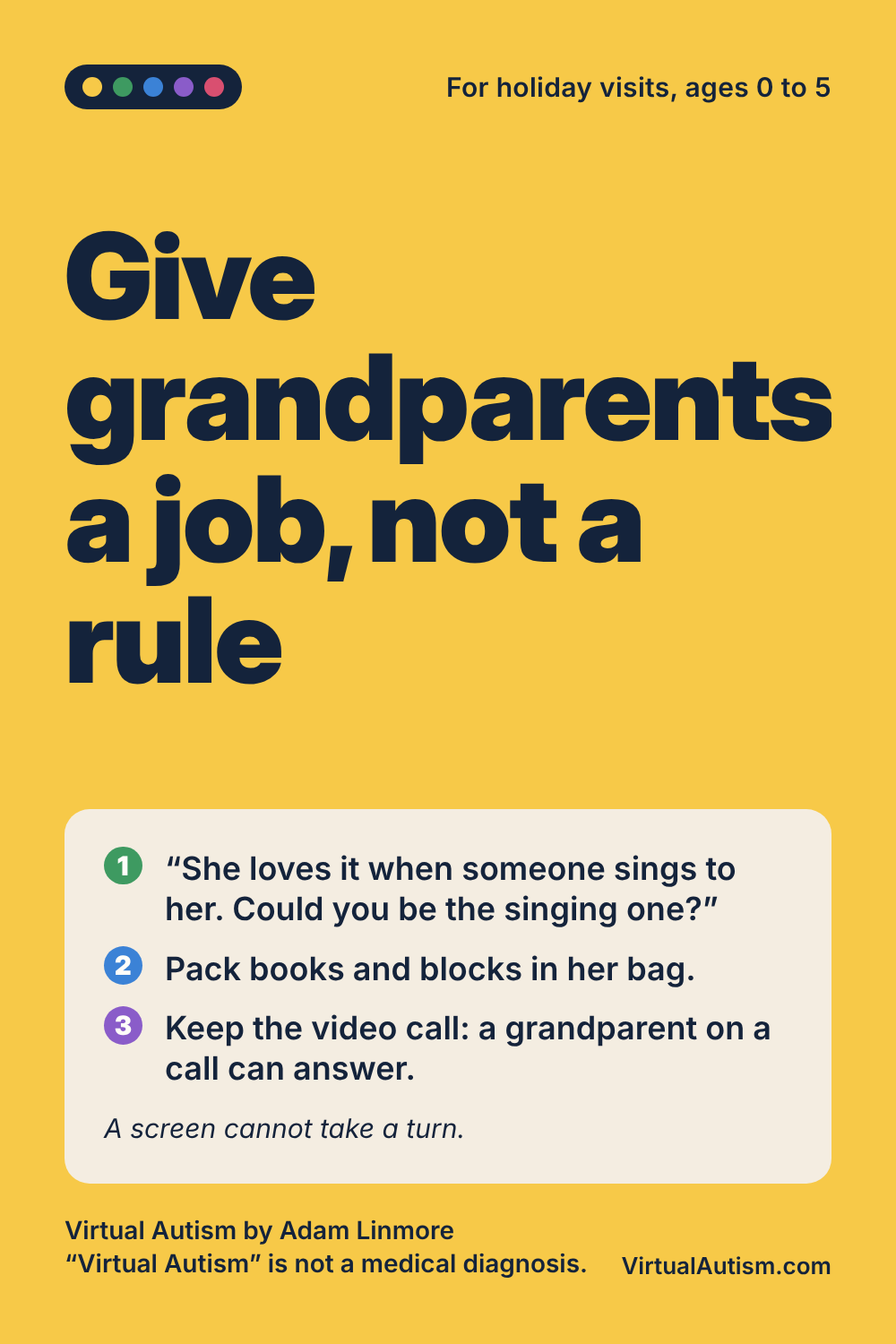
So give a job instead of a rule. “She loves it when someone sings to her. Could you be the singing one?” Or the one who walks her to the same tree every afternoon, or the one who reads the same five books forty times each. Few people in a toddler’s life have time for a job like that. A grandparent with that job will turn off the television to do it, and the child may remember the singing, and the tree, long after every program is forgotten.
A few practical steps help the visit go smoothly:
Say it before you arrive, in one short, warm sentence: “We’re keeping screens off for her this year. Books and blocks are in her bag.”
Pack the bag. A few books, a set of blocks and one toy she is not tired of make the hours easier for everyone.
Expect some loud days at first if she is used to a screen at that house. How to turn off screens with less protest has calm steps for that moment.
Leave the grown-ups’ television for after her bedtime, so nobody has to give up a favorite program.
The one screen worth keeping
There is one screen this advice is glad of: the video call. In one study, two-year-olds learned new verbs from an adult on a live video call, where the adult could see and answer them, and did not learn them from a recording of the same adult saying the same things. The screen was the same; the turn was the difference. Several major guidelines, the American one among them, make an exception for video calls for that reason.
For grandparents who live far away, that means calling often. On the call, skip the performance. Ask her what she is holding, and wait for her to show you. Do video calls count as screen time? explains more.
If you are worried
Grandparents have often seen more small children than the parents have, and they may notice something the parents cannot, because the parents see her every day. If she does not turn when you say her name, does not point to show you things, does not look up at your face, or has stopped doing something she used to do, say so, gently and once, and suggest that her parents talk with her doctor and ask for a hearing test first. Naming what it is belongs to a doctor; noticing belongs to everyone who loves her. No parent or grandparent is to blame for a child’s development. “Virtual Autism” is not a medical diagnosis; if that phrase brought you here, read what it means.
Sources: Common Sense Media 2025; Radesky et al. 2022; Kuhl, Tsao and Liu 2003; Christakis et al. 2009; Brushe et al. 2024; Kirkorian et al. 2009; Schmidt et al. 2008; Roseberry, Hirsh-Pasek and Golinkoff 2014; American Academy of Pediatrics 2016. Full references are in chapters 4, 11, 15 and 22 of Virtual Autism; the sources page lists the key studies behind this site.
Written with AI assistance and checked against the cited sources.